






A paint job shouldn’t start failing in a year.
If it does, something went wrong long before the peeling showed up.
Most homeowners don’t see the early signs. The walls look fine at first. Clean. Even. Fresh. Then small things start to change. A corner lifts slightly. Paint near a switch plate starts to separate. A patch looks dull and uneven.
It’s easy to think the paint just didn’t hold up.
That’s usually not the real reason.
Peeling Is a Surface Problem, Not a Paint Problem
Paint doesn’t fail on its own.
It fails when it doesn’t bond properly to the surface underneath.
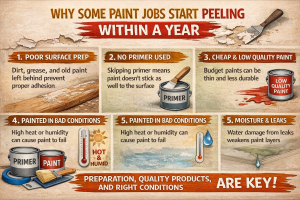
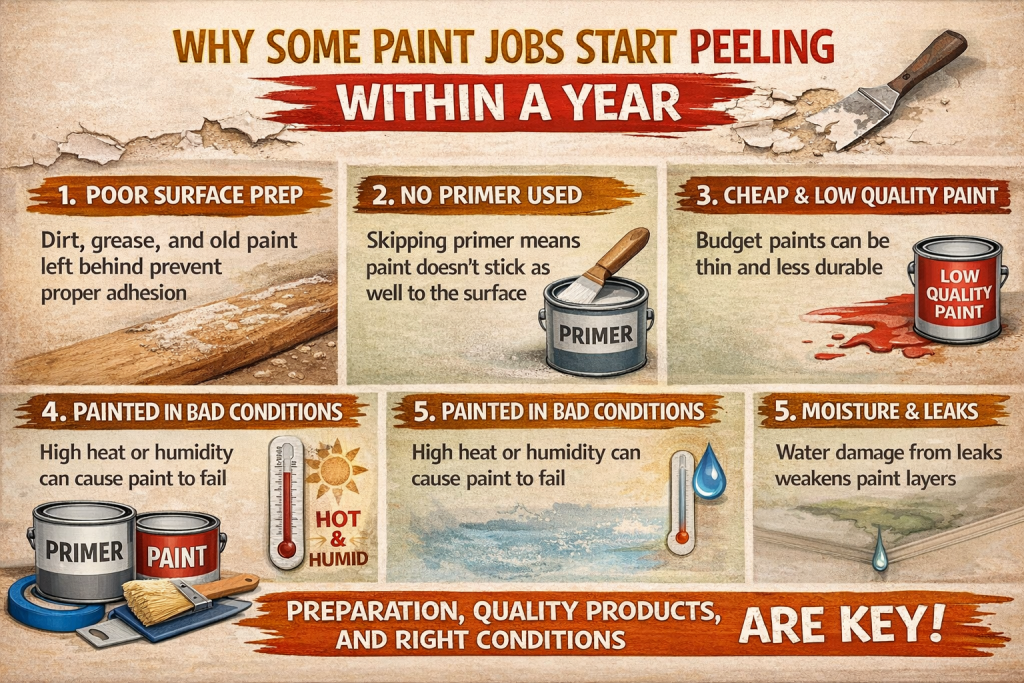
If the wall wasn’t prepared correctly, the paint sits on top instead of settling into the surface. It might look fine for a while, but over time, normal use starts to break that weak connection.
You see it first in high-touch areas. Around light switches. Along baseboards. Near doors.
That’s not random. That’s where the surface gets tested first.
The Most Common Cause: Incomplete Prep
This is where most problems begin.
Walls need to be clean before anything goes on them. Not just dusted, but properly cleaned. Grease, hand oils, residue from previous coatings, all of it affects how new paint behaves.
Then there’s the surface itself.
Small cracks. Nail holes. Rough patches. Old repairs. If those aren’t handled properly, the new paint highlights them instead of covering them.
A rushed job skips or minimizes this step. It saves time upfront, but the result doesn’t last.
This is where you start to see the difference in house interior painting services. The ones that hold up are built on preparation, not speed.
Painting Over a Failing Surface
Sometimes the issue isn’t the new paint. It’s what was already there.
If the previous layer is peeling, chalking, or unstable, painting over it doesn’t fix the problem. It just hides it temporarily.
Eventually, the new paint follows the same path.
You’ll see layers lifting together. Not just the top coat, but everything underneath it.
That’s why surface evaluation matters. You’re not just painting what you see. You’re working with everything beneath it.
Moisture Changes Everything
Walls aren’t static.
Bathrooms, kitchens, and even certain exterior-facing walls deal with moisture differently. If that isn’t accounted for, the paint starts to separate.
Sometimes it shows up as bubbling. Sometimes as peeling at the edges. Sometimes as a patch that never quite looks right.
This isn’t something better paint alone can fix. The surface needs to be dry, stable, and properly sealed before painting begins.
The Wrong Product for the Surface
Not all paints behave the same.
Some are designed for durability. Some for appearance. Some for specific surfaces.
Using the wrong type can create problems even if everything else is done correctly.
A coating that doesn’t match the surface or the environment won’t hold up the way it should. Over time, it starts to break down, especially in areas that see regular use.
This is one of those decisions that doesn’t look important at the start, but becomes obvious later.
Rushed Application
Even with the right prep and the right materials, timing still matters.
Paint needs time to settle and cure between coats. When layers are applied too quickly, they don’t bond properly with each other.
The result is a finish that looks fine initially but lacks strength underneath.
This kind of failure doesn’t show up immediately. It shows up months later, when the surface starts to separate in patches.
Why It Feels Like a Cost Issue
When paint starts peeling early, the first thought is usually about cost.
Was the wrong paint used? Was it a cheap job?
But peeling is rarely about how much was spent. It’s about how the work was done.
The professional interior painting cost of a project often reflects the time spent on preparation, surface correction, and proper application. Those are the parts that don’t stand out right away, but they’re what determine how long the finish lasts.
Cutting time in those areas is what leads to early failure.
What to Look for Before You Repaint
If your current paint is already peeling, the next step isn’t just repainting.
It’s figuring out why it failed.
Look closely at where the peeling is happening.
- Is it near moisture-heavy areas?
- Around high-contact spots?
- In patches that look uneven?
Those patterns usually point back to the cause.
Before moving forward, the surface needs to be corrected, not just covered again.
The Difference You Notice Later
Two homes can be painted at the same time and age very differently.
One still looks consistent a year later.
The other starts showing signs of wear within months.
The difference isn’t always visible on day one.
It shows up over time, in how the paint holds, how it wears, and how the surface responds to everyday use.
That’s why people searching for local interior painters near me often aren’t just looking for someone to apply paint. They’re trying to avoid going through the same problem again.
What It Comes Down To
Peeling paint isn’t unpredictable.
It follows a pattern.
Weak preparation.
Unstable surfaces.
Rushed application.
Fix those, and the finish holds.
Ignore them, and the same problem shows up again, no matter what color you choose next.
A paint job should settle into the home and stay there.
If it starts pulling away within a year, it was never properly attached to begin with.