





Some walls don’t get a break.
Hallways. Staircases. Entryways. The stretch of wall next to the light switch. The corner everyone brushes past without noticing.
These areas carry the weight of daily life. Hands, bags, shoes, furniture edges. It all adds up.
So when paint starts wearing down faster there, it’s not surprising.
What is surprising is how often it happens too soon.
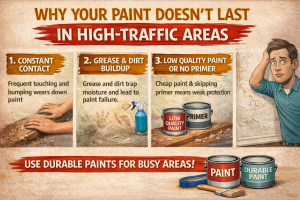
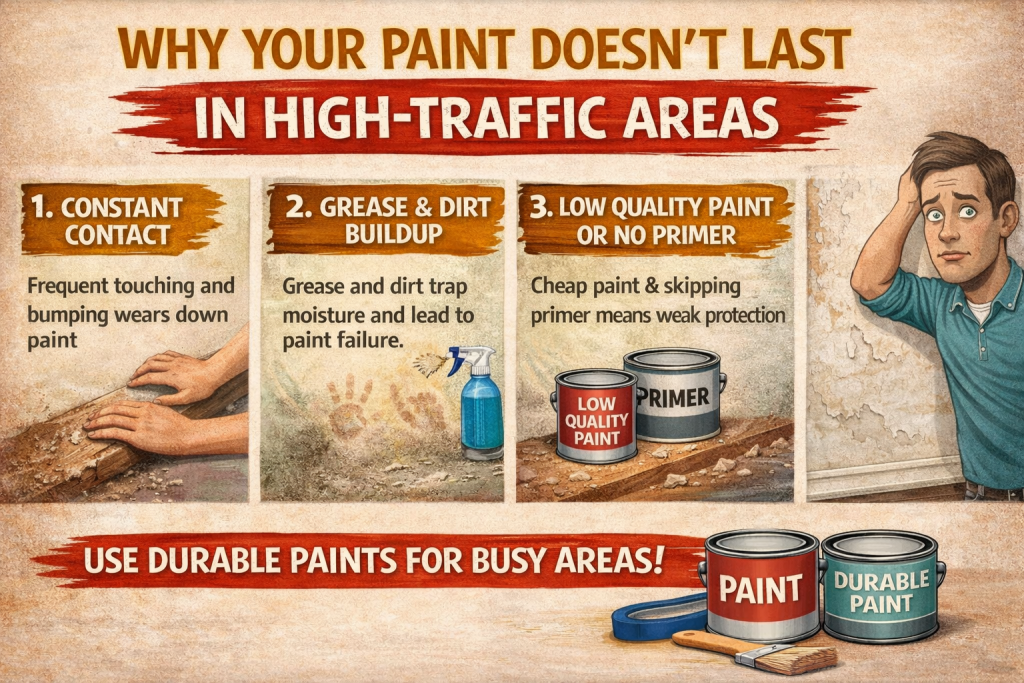
A paint job in a high-traffic area shouldn’t fall apart in months. When it does, the problem usually isn’t the traffic. It’s how the surface was handled before the paint ever went on.
High-Traffic Areas Expose Weak Paint Jobs
Paint holds best where it’s left alone.
Once you introduce constant contact, the surface gets tested.
You start to see it in small ways:
- dull patches where the sheen disappears
- marks that don’t wipe clean
- edges that wear down faster than the rest of the wall
These aren’t random issues. They show up in the same places every time.
High-traffic areas don’t create problems. They reveal them.
The Surface Wasn’t Built to Handle Contact
Walls in busy areas need more than just color. They need a finish that can take friction without breaking down.
If the surface underneath isn’t properly prepared, the paint never fully bonds. It sits on top instead of becoming part of the wall.
At first, everything looks fine.
Then cleaning starts to leave marks.
Then the sheen becomes uneven.
Then the surface starts to wear through.
That’s not about how often the wall is touched. It’s about how well the surface was built.
Cleaning Is Part of the Wear Cycle
Most people don’t think about this.
The more a wall gets used, the more it gets cleaned.
And cleaning is where weak finishes fall apart.
A properly finished wall can handle regular wiping without changing appearance. A weak one starts to show it immediately. The area looks dull. The texture changes. Sometimes it even feels different to the touch.
This is where you see the difference between a basic job and one handled by a careful interior painting company. The finish is built to hold up, not just look good for a few weeks.
Sheen Choice Matters More Than People Think
Flat paint hides imperfections. That’s why it’s often used.
But in high-traffic areas, it doesn’t always hold up well.
Lower sheen finishes absorb more light and tend to show wear faster when cleaned repeatedly. Higher sheen finishes are more durable but can highlight surface flaws if the prep isn’t done properly.
The balance matters.
Choosing the wrong sheen doesn’t always show up right away. It shows up after months of use, when certain areas start to look different from the rest of the wall.
Edges and Corners Take the First Hit
Flat walls wear down slowly.
Edges don’t.
Corners near doorways, the area around switches, the lower parts of walls near stairs. These spots get constant contact, often without anyone noticing.
If those areas aren’t handled carefully during preparation and application, they become the first to break down.
Paint thins out. Edges chip. The surface starts to look uneven.
Once it starts there, it spreads.
Rushed Work Doesn’t Hold Up
Time matters more than most people realize.
Each layer of paint needs time to settle and bond properly. When that process is rushed, the finish may look smooth but lacks strength underneath.
In low-use areas, that weakness might not show for a while.
In high-traffic areas, it shows quickly.
This is often the difference homeowners notice when comparing work from the best house painters in my area versus a quick, low-cost job. One holds up under daily use. The other starts showing wear much sooner.
It’s Not Just the Paint
When a wall starts wearing down, the instinct is to blame the paint itself.
But paint is only one part of the system.
What’s underneath matters just as much:
- how clean the surface was
- how well it was repaired
- how evenly it was prepared
- how carefully each coat was applied
If any of those steps are rushed or skipped, the result won’t last.
What to Look for Before Repainting
If your high-traffic areas are already wearing down, it’s worth taking a closer look before repainting.
Check where the wear is happening:
- around switches
- along baseboards
- in corners and edges
- along hallways
These patterns usually point back to how the surface was handled.
Repainting without correcting those issues just resets the clock. The same wear shows up again.
The Difference You Notice Over Time
Two homes can be painted the same week and look completely different a year later.
In one, the walls still feel consistent. Marks wipe off cleanly. The sheen holds.
In the other, certain areas start to fade, dull, or wear unevenly.
That difference isn’t about how busy the home is. It’s about how the job was done.
That’s why people searching for the best painters in my area are often trying to avoid going through the same problem again.
What It Comes Down To
High-traffic areas don’t destroy paint.
They expose weak preparation, poor application, and rushed work.
When the surface is built properly, the paint holds. It wears evenly. It handles daily life without drawing attention to itself.
And that’s really the goal.
Not just walls that look good when they’re finished,
but walls that still look right after they’ve been lived with.